Self-reliance.

The great goal of The Hunger Project is self-reliance: well cooperating villages that themselves continue on their way to the end ofhungerand poverty. And who can tackle new challenges together, without further support from The Hunger Project.

What is self-reliance?

In 9 countries in Africa, The Hunger Project works with clusters of villages:Epicentres. With a large number of trained and active volunteers, and smart partnerships with local government, for example, they are working on their ultimate goal: self-reliance.

In a self-reliant epicentre, the management of the service centre and all functions lies in the hands of the residents. The epicenter has its own recognized rural bank and enough income. There are strong leadership committees with a good mix of men and women, and there is a lot of community initiative. The health, education and information programmes are organised by active volunteers.

From poverty reduction to empowerment of women and improved food security: There is considerable progress. And they go on with that, with the confidence that they can achieve their own goals with their own resources.

Hooray! We say goodbye

When an epicenter officially becomes self-reliant, it goes on without The Hunger Project. We no longer invest time, force or resources in the area. Without support, the epicenter continues to play its role as a driving force for local development. We say goodbye with a big party, celebrating what has been achieved.

Self-reliance is not self-sufficient.

Self-reliance does not mean that there is no hunger or poverty at all. Whether everyone has access to clean water or knows their HIV status. Not necessarily every existing need or question has been answered, but it is clearly improving. The most important thing is that the community itself runs the village. And that they know for sure that they can meet new challenges, even in adversity – towards the end of hunger and poverty for all.

Criteria for self-reliance.

A self-reliant epicenter manages the epicenter building from food bank to kindergarten and clinic. Land rights for the building are essential to self-reliance, as are official recognition of the epicenter by the local government.

An epicentre must also score enough on 17 self-reliance indicators spread over 9 goalsThis appropriation is intended to cover commitments remaining to be settled from previous years.

Measure your own progress.

The inhabitants of the epicentres set their own priorities and targets within the 17 indicators. This is how they determine their own criteria for self-reliance. The villages also measure their own progress. And they can compare them to other villages in their country.

Changemaker

We have made good agreements with the local government, so that the facilities keep running. For example, we are in contact with the health clinic, agricultural training, education and social work. I have faith in it.

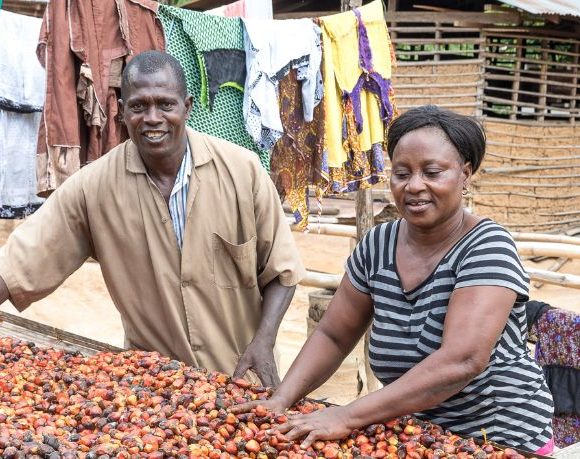
Now that epicenter Adonkwanta has become self-reliant, maintainsHayford from Ghana(here on the picture with his wife Vida) part of the contact with the local government. Hayford and Vida are closely involved in the epicenter, and their role becomes extra important as the epicenter continues without The Hunger Project.

Photo: Johannes Ode

Results and impact.

These are the average results from the final evaluations of 90 epicenters, compared to the midterm evaluations, which we decreased 3 to 4 years before the final evaluation. Because we have not done a baseline at each epicenter, the starting situation is not included, which is why the actual change over the total period is expected to be greater than these figures, because it only shows the change over the last three years.

0
%
less hunger And the number of people living in poverty fell by 25%.
0
%
more households have a vegetable garden. That's a good 26%
0
%
the participants are convinced that they can set up their own future. Almost 64,000 people followed a VCA workshop in 2023.
0
%
of farmers uses improved farming techniques
0
%
more women have a business
0
%
less child marriages.

Self-reliant .. and now what?

Of course, we are extremely proud of the self-reliant epicentres. In 2025, the 90th epicenter in Africa declared itself self-reliant. This means that nearly 1.4 million people live in a community that goes on its own (Annual Report 2025 of The Hunger Project).

And even if we say goodbye, we don’t let each other go completely. We continue to follow how the community continues to evolve. In order to gain a better understanding of this, we have now commissioned an independent external investigation at 4 self-reliant epicentres, more than 3 years after they had declared themselves self-reliant. We were looking into what’s left of that now. The first ex-post evaluation shows that social infrastructure stands like a house. And although there is still an improvement in some areas, the epicentres still act as an engine for change, led by the people themselves.

Contribute to sustainable solutions.

Clusters of African villages work at the end of hunger and poverty, on their way to self-reliance. After a number of years of training and guidance by The Hunger Project, they continue independently. In cooperation with each other and their local authorities, they address new challenges with their own knowledge and resources. This creates sustainable change. Do you contribute to that?
Photo: Johannes Ode