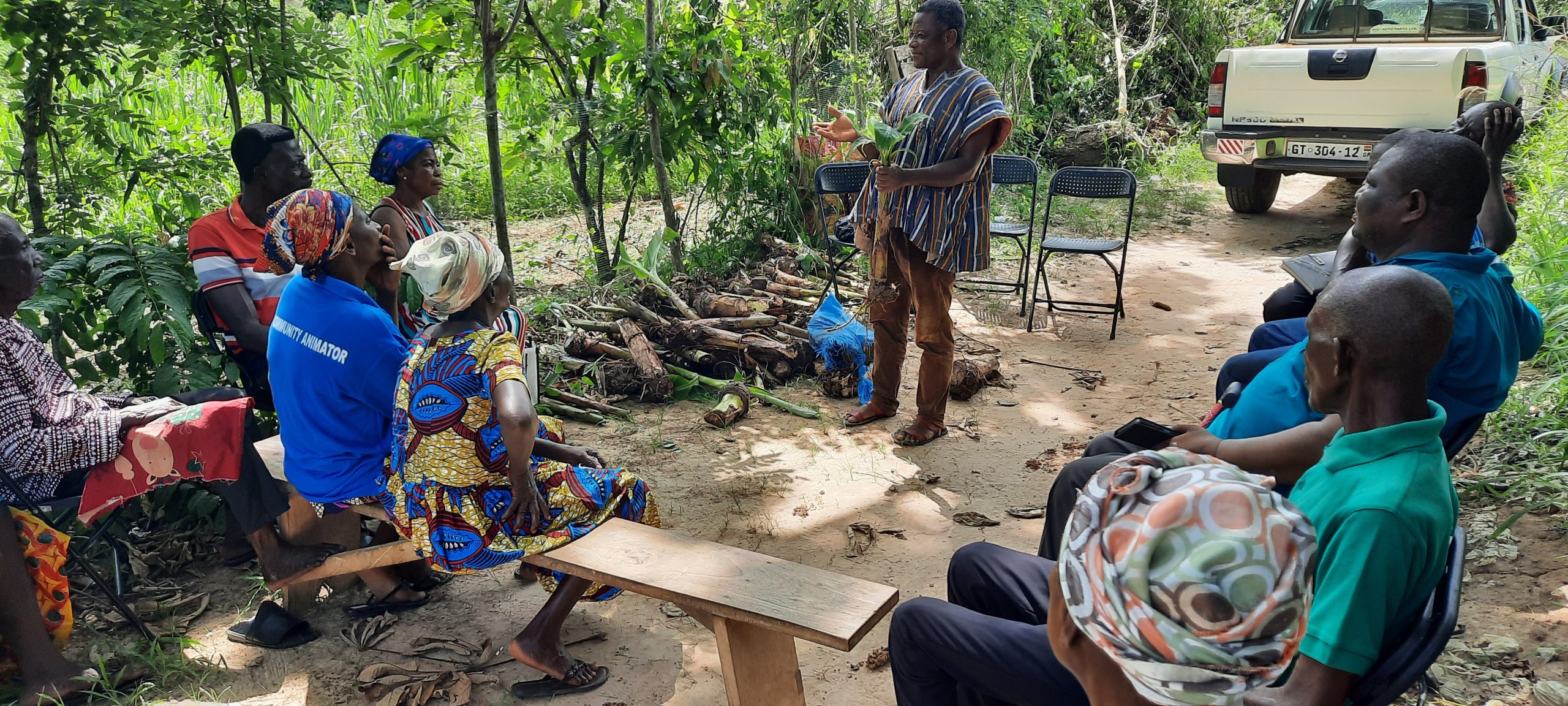
Epicenter strategy.
In 9 African countries, The Hunger Project is working on ending hunger through the epicentre strategy. Clusters of villages themselves work to improve their living conditions, in 4 concrete steps over a period of about 8 years. The community has the lead. The goal: self-reliance. So villages will eventually continue without support from The Hunger Project.
Epicenter: engine of change.
The Hunger Project has nothing to do with earthquakes. Physically, an epicenter is a service centre in the middle of a region that has built the village community. An epicenter reaches 10 to 15 villages within walking distance of the town of . On average, 10,000 to 15,000 people live there.
In the epicenter building is a kindergarten, a medical post, a women-run microcredit bank, a training room and a food bank. All these services are organised and managed by the community itself. This is how these people work together to improve their living conditions. Symbolically, the epicentre is proof of the community’s efforts. The building is the heart of change.
Self-reliance: on the road to improvement for everyone.
Our great goal in epicenters is self-reliance: well-cooperative village communities themselves moving towards the end of hunger and poverty. And who are able to effectively tackle new challenges together. Without further support from The Hunger Project. In the meantime, we have proven 78 times that it can.
1.2 million people are self-reliant.
In 2015 we celebrated that the first epicenter in Ghana became self-reliant. In 2023, 3 epicenters achieved self-reliance, and 12 epicenters took the final steps towards that goal. By the end of 2023, the counter was 78 self-reliant epicentres, consisting of 1,275 villages. Over 1.2 million people live there: 1,248,048 people, to be exact. And by 2023, there were 30 active epicentres.

The first step: It’s possible.
The very first step of the epicenter strategy is to believe that things can be different: from I can. Because taking action without confidence is difficult. In Vision, Commitment and Action (VCA) workshops are challenged to formulate their dreams and vision for a better future. They themselves make concrete and feasible plans to realize those dreams, by looking at what can be done. And they carry out those plans themselves, with as many local resources as possible and with support from The Hunger Project.
The community in the lead.
In an epicenter the coaching and guidance is provided by the local trainers and experts of The Hunger Project. But all the program performances are organized, managed and executed by the people themselves. This is precisely where the strength of permanent development lies.
These local volunteers we call animators. They are enthusiastic about the new possibilities they see and take the lead in their village. The Hunger Project trains them, so they can practice again. These changemakers convey their knowledge and experience to their own community and inspire them to action. They show what is possible and motivate their villagers.
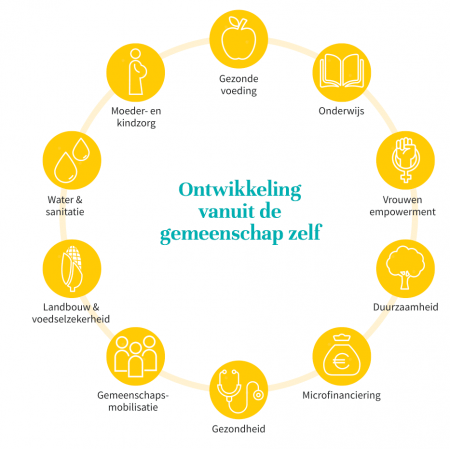
Hunger is about more than just food. That is why the epicenter tackles all the factors involved in hunger and poverty. We are not working on either agriculture or women’s rights or on education, but on the contrary, we are integrating everything at the same time.
From information on health and good nutrition to training on agricultural methods. From education for children and adults to safe savings and loans. And to strengthen forerunners and . . especially female . . local leaders.
Integrated approach.
Hunger is about more than just food. That is why the epicenter tackles all the factors involved in hunger and poverty. We are not working on either agriculture or women’s rights or on education, but on the contrary, we are integrating everything at the same time.
From information on health and good nutrition to training on agricultural methods. From education for children and adults to safe savings and loans. And to strengthen forerunners and . . especially female . . local leaders.
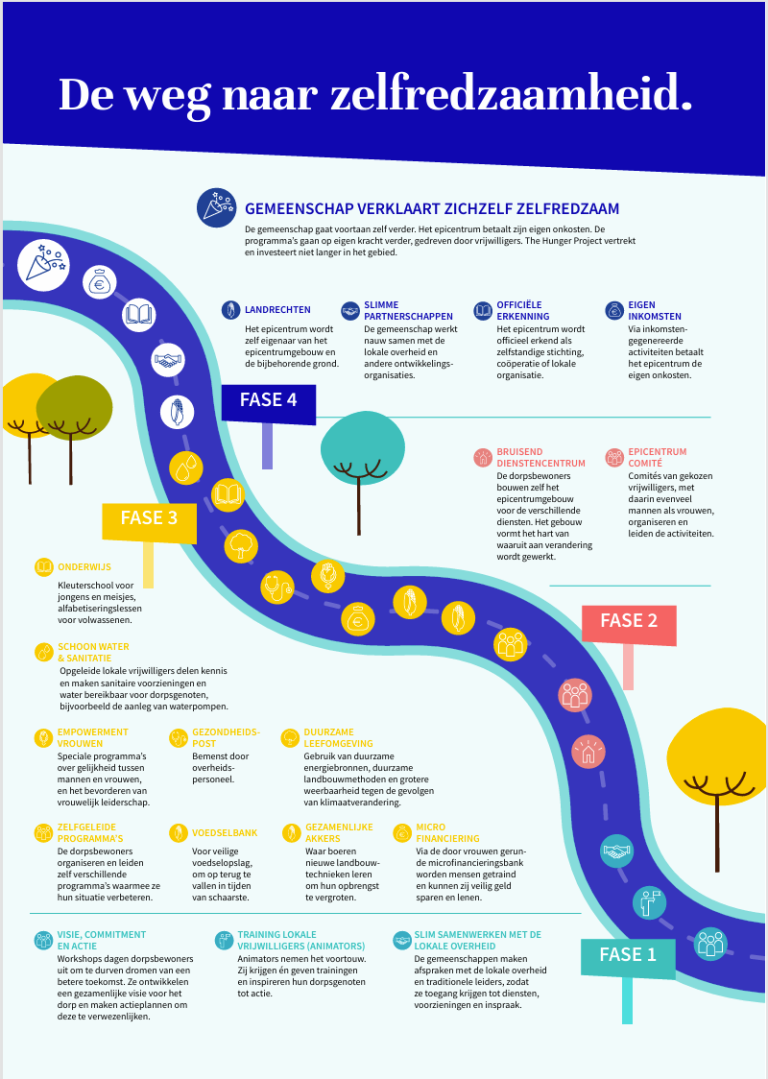
4 phases of the epicentre strategy.
Through the epicentre strategy, we work in four concrete steps towards self-reliance over a period of about 8 years:
- Take action: The villagers share their dreams about the future and make their own concrete and feasible plans to realize these dreams.
- Construction of the epicentre: Villagers build the epicentre building themselves, starting workshops.
- Extension of epicentre services: local leaders train their fellow villagers, microfinance, health and kindergarten programmes.
- Towards independence: own income, reduction of support by The Hunger Project.
Close cooperation with the local government.
A close partnership with local authorities, together with revenue-generating projects, contributes to an independent epicentre. That’s why The Hunger Project makes agreements with the local government about infrastructure, healthcare and educational facilities.
Read about the epicenter strategy on the THP Global website