Monitoring, evaluation and learning.
How do we know if our programmes make a difference? Or they really end hunger and poverty? Through monitoring, evaluation and learning (MEL), we map the impact of our work well and know how successful we are. Or we learn what it takes to make more change. MEL within The Hunger Project is hindered, just like all our work.
Participatory approach.
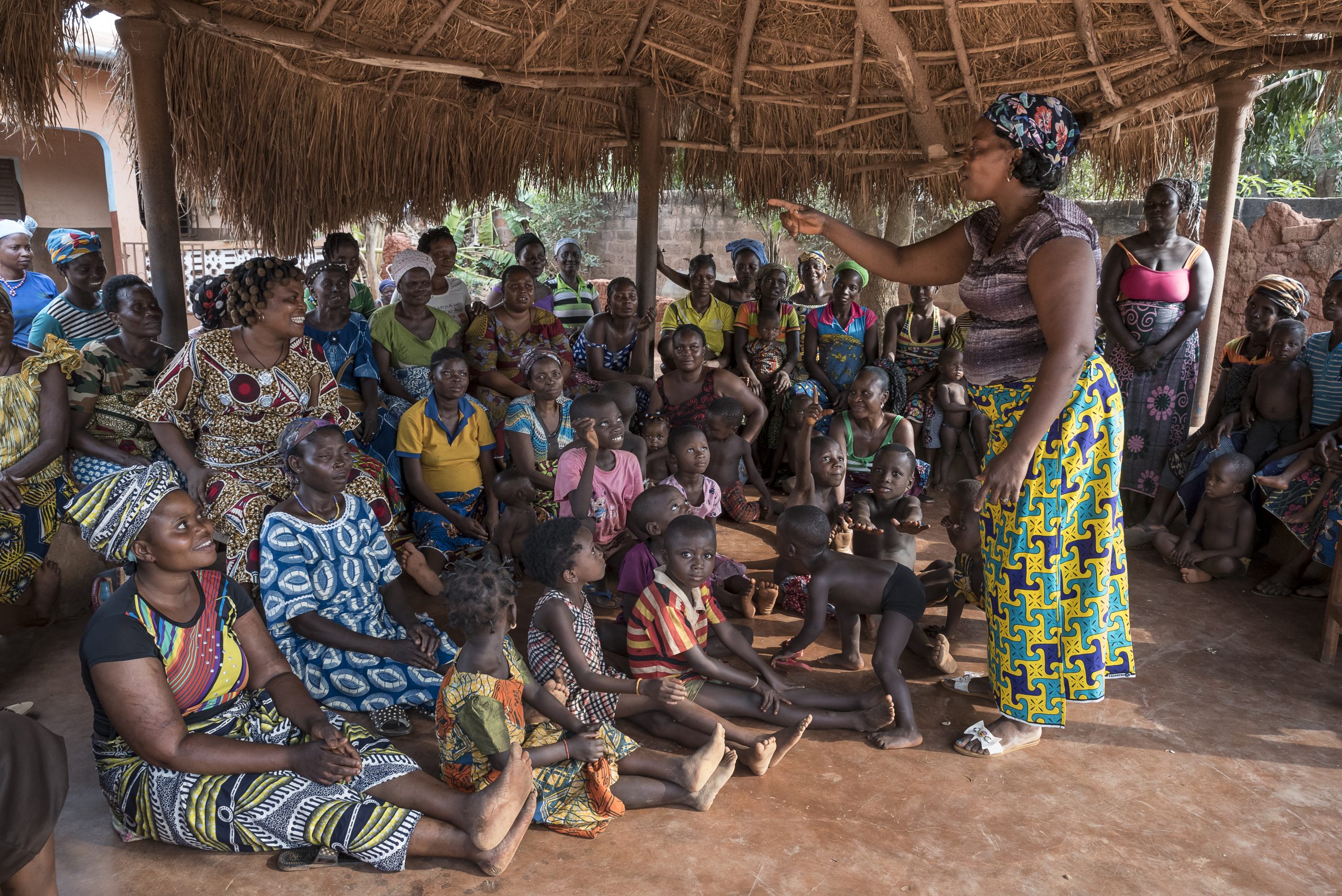
MEL within The Hunger Project is hindered, just like all our work. This approach fits in with the principle ofcommunity-led development, where change is organised from below. We think it is important for village communities to set their own goals, for example that the number of people who have access to clean drinking water will increase from 50% to 80% within 5 years. And we think it is important that they can measure and monitor the impact of their own efforts.
We train local volunteers in the villages, so they can collect and analyze their own data. For example, thematic committees each quarter determine how many people they want to reach through village meetings. These committees are responsible for monitoring, sharing and discussing their range figures.
The ex-post evaluation (read more below) in Ghana and Malawi called celebrating achievements one of the unique, effective features of The Hunger Project.
Explain and use data.
Measurement methods.
The Hunger Project uses as many global indicators as possible, such as the Sustainable Development Goals, the Food and Agriculture Organization (FAO) and USAID. However, sometimes the context requires a different approach, or an international standard indicator is missing. Then The Hunger Project develops its own measurement method, such as the Women Empowerment Index and the Climate Resilience Index.
Women’s Empowerment Index.
Women are crucial to the end of hunger. Although women’s empowerment is central to many organisations, a good method of measuring results was lacking. That’s why The Hunger Project developed the Women’s Empowerment Index. We are thus mapping progress in the areas of self-determination, income, leadership, access to resources and knowledge, and finally time spent. Not only with regard to women’s progress, but also to men. Because women’s empowerment is not about women alone. That is why we also look at how the results relate to the situation of the men in the same village. With the Women’s Empowerment Index we can do our job even better and support women as best we can.
► More about the Women’s Empowerment Index►Women’s Empowerment Index Toolkit
Climate Resilience Index
We developed the Climate Resilience Index, with which we together with a farming community map the climate risks of their environment. This index is based on the 114 indicators and 12 key themes of the Committee on Sustainable Assessment (COSA). The Hunger Project has reduced them to 12 core indicators, each representing a core theme, such as shock & risk, water, soil, and biodiversity. They were then optimised for the rural communities with which The Hunger Project works. The higher the score, the more resilient the community is. Although the climate challenges remain high, the self-reliant epicentres scored at the Climate Resilience Index increased by 25%.
►More about the Climate Resilience Index►More about Climate Resilience Index goal 9: improve environmental and climate resilience in rural communities
Right2Grow.
The Hunger Project Netherlands is the leader of the strategic partnership Right2Grow. Learning takes an important place within Right2Grow. Much attention is paid to sharing experiences, best practicesAnd brilliant failures. In 2023, we had a mid-term evaluation of the programme to determine what had been achieved and how we could make even more impact. From the evaluation we made a number of recommendations. For example, cooperation with the local private sector should improve, as should the lobbying strategy towards financiers (other than government) and other international stakeholders. Thus, the impact of Right2Grow can be greater than only in the 6 program countries.
In September 2023, 80 employees from 27 different organisations involved in Right2Grow met in Uganda to discuss the results of the research, exchange experiences and learn from each other.
► Read more about the results in the annual report 2023► Download the evaluation► Watch a video impression of the Right2Grow learning week
External final evaluation in India.
The Hunger Project Netherlands finances through theOdisha. 100-network especially the work in the state of Odisha. The Hunger Project India commissioned an independent final evaluation of the impact of this programme from 2017 to 2021. The evaluation shows that trained women are better aware of the various government schemes, more self-confidence and better equipped to carry out their responsibilities than at the start of their term of office. The female leaders and their work more accepted and recognized by other stakeholders, such as community members, elected village council members and civil servants. In addition, the strength of cooperation between these women is clearly reflected in the evaluation.
►View the report of the external evaluation (English)►Read the main conclusions in this summary (Dutch)►More on the results in the Annual Report 2021
Child marriages.
From 2016 to 2020, The Hunger Project, Stichting Kinderpostgels and ICDI worked together in the Her Choice alliance to reduce child marriages. Research partnerAmsterdam Institute for Social Science Research(AISSR) from the University of Amsterdam (UvAIn the meantime, he kept his finger on the wrist. Upon completion of the programme, AISSR/UvA carried out a final evaluation and Avance carried out an external evaluation.
From thefinal evaluation of AISSR/UvAIt appears that the number of child marriages fell sharply in the areas of work in Benin, Burkina Faso, Mali, Bangladesh, Nepal and Pakistan. This decline continued in some places even in the last corona year. And the number of girls who feel that they have control over or, when and with whom they want to marry increased in all countries. For example, in Ghana 91.1% of girls now feel that she has control over marriage decisions, while at the start of Her Choice this was only 39.5%. And in Bangladesh this increased from 6.3% to 42.1%. This is the result of more knowledge and skills in girls and boys, combined with support from families, communities, schools, health services and the law.
Theexternal evaluationby Avance charted the success factors of Her Choice:
- The integrated approach: action on multiple fronts simultaneously
- Involvement of the whole community, including boys and men
- Respond to changes in the environment and gradually adjust the approach, for example around corona: New causes call for new approaches
- Sharing knowledge and experience between partners
►UAISSR/UvA impact assessment►Summary of external evaluation Avance►External evaluation Avance►Impact pager Her Choice
Evaluation Malawi – Majete programmes.
At the request of the Dioraphte Foundation, fund 6 epicentres around theMajete Wildlife Park in MalawiIn 2018, Phil Compernolle and her Malawian counterpart Alfred Dzilankhulani conducted an external evaluation to investigate the effectiveness of the Majete program “The Hunger Project.” The evaluation has given us insight into the strong and weak elements of the epicentre strategy that is being carried out around Majete.
►Majete evaluation►Response to the Majete evaluation
Evaluation Bangladesh.
In 2016, a renowned external institute, Transtec, commissioned by United Nations Democracy Fund (UNDEF) evaluated our program in Bangladesh. The evaluation shows that 49% more people think women should be actively involved in politics, 48% more people believe they can change their communities themselves and the number of people who knew nothing about their rights decreased by 51%. The programme makes local leaders aware of basic human rights and brings the interests of the local community to the attention of politicians.
Working together, measuring together
Monitoring and evaluation within The Hunger Project aims to direct people’s lives. Our approach is long-term. We follow the communities we work with for several years to learn which works well and which doesn’t. And whether our programmes really put an end to hunger and poverty. We think it is important that village communities themselves can measure the impact of their own efforts. This participatory approach fits with the The Hunger Project.